This August has been a blast spinning records at Devil’s Purse Brewing Company, and while the summer’s over, there’s no reason we can’t continue the fun into the shoulder season! We’re working out the deets, but a little birdy tells me there is a good chance you might see some vinyl Friday afternoons. Be sure to follow me here or on Instagram, and give Devil’s Purse a follow too for more information, dates, and hours!
Blog
-
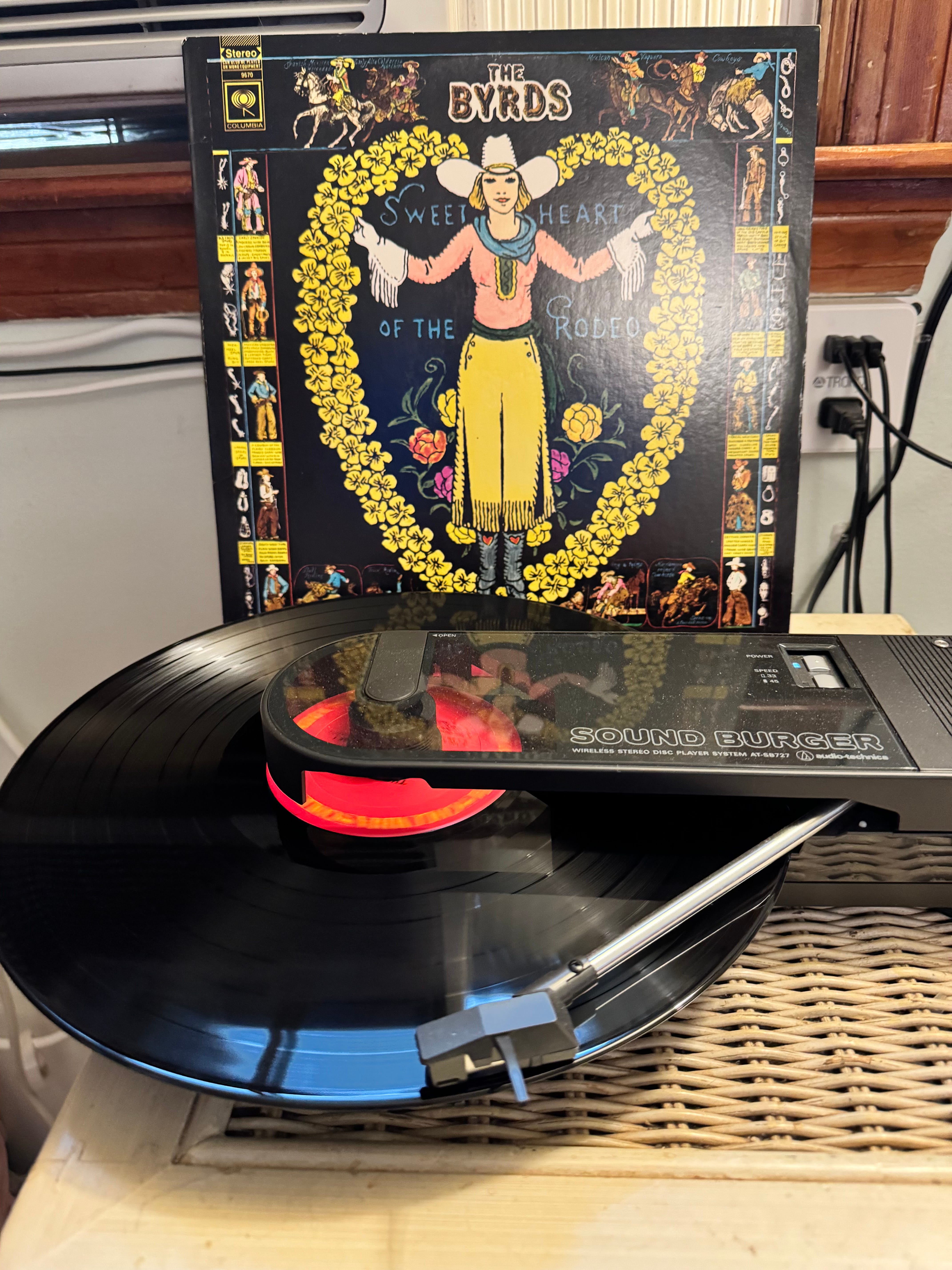
Record Store Treasures: Sweetheart of the Rodeo

There are some albums that never show up in my local used record shops. This is one that I had my eye on for a while, and almost ordered new, but I really wanted a used copy. My patience paid off on this trip, and in a way it was destined. I first found two copies when digging through the stacks at Retro Rewind in Bel Air, MD, but it was early in my trip and I decided to hold off. Later, I found a new copy in Celebrated Summer in Hamden, but again I opted to go for a used dB’s album instead. So when I found another two copies in the used stacks in a “way home” stop at Princeton Record Exchange, I felt it was destined for me to pick this up.
Sweetheart of the Rodeo is a story of two trajectories intersecting: the Byrds’ on the last part of their arc, and the start of Gram Parsons’ brief but impactful influence in what would become Americana or Alt. Country. Sweetheart was originally conceived to be a history of American music and covering many genres including country, jazz, and blues. However, Gram Parsons, who had initially been hired as a salaried keyboardist, started exerting more and more influence over the album, using this as an opportunity to introduce country music to a wider rock audience. Parsons contributed two songs to this album, “Hickory Wind” and “One Hundred Years From Now,” and originally sang lead on six of the eleven songs. However, legal threats from Gram’s former label combined with Roger McGuinn’s feeling he was losing control of his band prompted Chris Hillman and McGuinn to re-record three of the vocals, including Gram’s own “One Hundred Years From Now.” That move infuriated Parsons, who sniped that McGuinn “erased” the vocals and “fucked them up.”
Parsons would last only a few months in the Byrds. At the end of a tour leg in the UK, Parsons refused to go on the next leg to South Africa, choosing instead to stay behind and hang out with the Rolling Stones’ Mick Jagger and Keith Richards. Parsons stated that he was opposed to the apartheid government in South Africa at the time, but Hillman and McGuinn suspected that he just didn’t want to be in the Byrds anymore. His time in the Byrds lasted less than five months. Gram was let go, and went on to form the Flying Burrito Brothers with Hillman, who would leave the Byrds after recording the next Byrds album. Parsons would end up recording two Flying Burrito Brothers albums and one solo album before dying of an overdose in 1973. He’d have one more posthumous album released in 1974.
Sweetheart of the Rodeo, as well as his solo work and the Flying Burrito Brothers work, was largely disliked or ignored during his brief five year recording span, but his influence was felt then, and now. His time with Keith Jagger led him to a more countrified sound in both Let It Bleed and Exile on Main Street, and likely influenced or paralleled similar musical movements in Bob Dylan’s Nashville Skyline and the Band’s Music from Big Pink. This album and the Flying Burritos albums are directly credited as a precursor to alt-country, with bands and artists like Uncle Tupelo, Wilco, Ryan Adams, and Jason Isbell noting his influence.
Despite being critically divisive at the time and far from a fan favorite, this has evolved to become one of the “must have albums,” reaching #117 in Rolling Stone’s 500 Greatest Albums of All Time and #133 in Robert Dimery’s 1001 Albums You Must Year Before You Die. And I agree. This is an album that deserves to be heard, and heard on vinyl if you can get it.
-
Liner Notes – Baliene Vinyl Night – Thursday July 10th
A large part of the vinyl listening experience is checking out the liner notes: the lyrics, stats, and other cool facts and fiction that bands slip into the sleeve to enhance your enjoyment of the album. In that spirit, I’m assembling ‘liner notes’ of my own for my vinyl gigs, giving a little background into my thought process in choosing the albums, as well as little facts or stories to add a little flavor to the gig. And just like liner notes, these are meant as a companion piece: by no means essential, but hopefully interesting. If you’re reading this before July 10th, make sure you mark your calendars and come out to Baliene and hear the set! And with that, here we go…
Vinyl sits firmly in the analog camp, and the first two bands I’m featuring, Stereolab and Air, both purposefully chose analog equipment over digital equipment when making their albums, yet both manage to fit in with the more digital 90s era. These two albums set a very dreamy, cinematic soundscape that sets the stage perfectly for the next artist on the slab: Kate Bush.
This album, like many in this setlist, is made specifically for vinyl listening. There are two separate “sides” to this album: the “Hounds of Love” side and the “The Ninth Wave” side, a conceptual suite that invokes Tennyson’s “ninth wave” representing the largest wave and the most dangerous, as well as a cleansing wave. In it, the protagonist begins floating at sea, worries about drowning, fights for survival, and eventually experiences a spiritual rebirth. An interesting side note: to maintain complete control, Kate built a 24-track studio at her home, which was unusual in and of itself, but rare at the time for female artists. A case could be made that it helped pave the way for modern artists like Taylor Swift to take control of their music.
The next album up is Fiona Apple’s second album, When the Pawn…, a huge departure from the sultry jazz-pop of her first album into more experimental arrangements, helped by her frequent cohort Jon Brion. This new album was far more percussive and confrontational, with more rhythmic complexity and odd time signatures, which work to mirror the lyrical content. Many of the vocals were also done in one take, adding to the “imperfections” that you might hear in an analog record. And for those wondering, here is the full title of the album:
When the pawn hits the conflicts he thinks like a king
What he knows throws the blows when he goes to the fight
And he’ll win the whole thing ‘fore he enters the ring
There’s no body to batter when your mind is your might
So when you go solo, you hold your own hand
And remember that depth is the greatest of heights
And if you know where you stand, then you know where to land
And if you fall it won’t matter, cuz you’ll know that you’re rightOur next two albums, Tricky and Portishead, straddle the fence between lo-fi and hi-tech, embracing muddy mixes, sampling, tape hiss, and vinyl crackle to create a haunting, sometimes moody or even nightmarish melody. Interestingly, both “Hell Around the Corner” and “Glory Box” from this set sample Issac Hayes’ “Ike’s Rap II” (check around 30 seconds in).
Radiohead’s Amnesiac is considered to be the sister album to their breakthrough album Kid A, recorded at the same time. Like Tricky and Portishead, they combine vintage instruments and equipment with modern samples, including reversed audio tapes, glitched samplers, and field recordings, to create a surreal, lost, and foggy atmosphere. This is the kind of album that rewards repeated listening.
Morphine takes a bit of a sonic right turn from what we had up until now but still embraces smooth, jazzy, and kind of smoky melodies that invoke analog warmth. Recorded mostly live, their sound is distinctive: lacking guitars, with baritone sax and Mark Sandman’s murmured vocals over an almost minimal drum kit, this gives a loose, almost improvised feel. Interesting tidbit, Dana Colley sometimes played two saxophones at once, something he picked up from jazz legend Rahsaan Roland Kirk.
Next up is Jeff Buckley’s only album released while he was alive, before his tragic death at age 30. This album spans multiple genres, from rock to soul to jazz to psychedelia, and continues the moody heartbreak feeling from Morphine’s album, though this pain is more rooted in the romantic. His voice, particularly on songs like “Lilac Wine,” pulls you into an intimate conversation, and the album builds as it progresses. Like many of the albums here, this was mostly recorded live in the studio, giving it a cohesive and spontaneous feel. Given how much his howl and vocal range recalls early Robert Plant, it’s almost fitting that when he drowned during the recording of his second album, My Sweetheart the Drunk, he was fully clothed and last seen singing Led Zeppelin’s “Whole Lotta Love.”
Lush, atmospheric soundscapes best describe the Cocteau Twins Blue Bell Knoll, their most accessible album to feature Fraser’s obfuscated vocal style before Heaven or Las Vegas gave way to more clearly understandable lyrics. This album paved the way for dream pop, and each side provides a sonic lullaby for the listener.
If the Cocteau Twins dreamed you to sleep, then the Stone Roses will groove you awake. One of the greatest debut albums of all time, the Stone Roses took the jangly guitars of the 60s and merged them with acid house rhythms that helped shape the “Madchester” sound. The song “Don’t Stop” is a reversed remix of the previous song, “Waterfall,” with new vocals, a nod to 1960s tape experimentation.
Motown initially didn’t want to release Marvin Gaye’s What’s Going On, and Berry Gordy called it “the worst thing I’ve ever heard.” However, Gaye refused to record anything else until it was released, and when the single “What’s Going On” became a hit, it forced them to greenlight it. This is an album that demands to be listened to as a whole, as one song bleeds into the next, and tells the story of a Vietnam vet returning home to a world of violence, racism, poverty, and urban and environmental decay. This is one of the first concept albums in soul/R&B history. At the time, Gaye was grieving the death of Tammi Terrell, his collaborator and partner on “Ain’t No Mountain High Enough,” which adds to the somber mood.
Rounding out the set is Amy Winehouse’s Back to Black. Bringing back the sounds of Motown soul and 1960s girl group heartbreak, Winehouse combines Northern Soul, jazz, ska, hip-hop, and gospel and lays the entire emotional wreckage on tape. Mark Ronson emulated Phil Spector’s “Wall of Sound” production style to great effect, and like many other albums on this list, the vocals were done mostly in one or two takes. Vinyl makes this experience even richer, as the mix and master for the vinyl is different from that used for digital (CD and streaming), with the vinyl having less compression and more dynamic range and natural sound, as opposed to the punchier, less nuanced digital mix.
That’s all for now but check back after July 8th when I’ll drop the playlist on Apple Music and Spotify.
-
Why Vinyl Still Rules
Sample article. If this were an actual article, there would be sizzling phrases and phantasmagorical sentences here.
Photo by Samuel Regan-Asante on Unsplash